Return to Run After ACL Reconstruction: A 3-Phase Protocol
What the research actually says about when to start jogging again — and the three movement checkpoints every knee should clear before pavement.
Most ACL patients ask the same question at month four: "When can I run again?" The honest answer isn't a calendar date — it's a set of capacity checkpoints your knee has to clear first. Surgeons clear graft healing; physical therapists clear function. Both opinions matter, and they aren't always saying the same thing on the same day.
Here's the protocol we use with athletes and active adults at Elev8 — built from the current sports medicine literature, but adapted to what each individual knee is actually doing in front of us.
Why timelines fail and capacity wins The classic "12 weeks and you can run" model fails about as often as it succeeds. Graft strength and tissue healing follow a predictable curve, but neuromuscular control — the part that protects you from re-tearing — varies wildly between patients. Two knees at the same week post-op can have radically different readiness profiles. Re-tear risk drops sharply when return-to-run is gated by capacity, not the calendar.
Phase 1 — Foundation (Weeks 12-16) Before any return-to-run conversation, the operated leg has to demonstrate:
- **Quad strength symmetry within 80%** of the non-operated side, measured on a handheld dynamometer or isokinetic device.
- **Full passive knee extension** matching the other side. A 3-degree extension deficit is enough to disrupt running gait and load the meniscus poorly.
- **Pain-free single-leg squat to 60 degrees** with no knee valgus (collapse inward) and no Trendelenburg (hip drop).
- **Single-leg balance**, eyes closed, 30 seconds on each leg, on a firm surface.
If any of these fail, we don't talk about jogging yet. We rebuild the foundation. This is where most home programs fall apart — patients feel "fine" walking and assume they're ready, but the asymmetries you can't see are the ones that re-tear the knee.
Phase 2 — Capacity (Weeks 16-22) This is the bridge most patients skip. They jump from squats to jogging without building the eccentric and reactive capacity their knee needs to absorb landing forces. Running is, biomechanically, a series of single-leg landings — each footstrike absorbs 2.5-3x body weight.
What we build in this phase:
- **Bilateral jumping** — squat jumps, broad jumps, lateral jumps. Focus on soft, quiet landings with knees tracking over toes.
- **Single-leg hopping** — forward, lateral, rotational. Hop testing battery (single hop, triple hop, crossover hop, 6-meter timed hop) should reach 90% of the non-operated side before pavement is on the table.
- **Reactive cutting drills** — start with planned cuts at 30%, build to unplanned cuts at full speed.
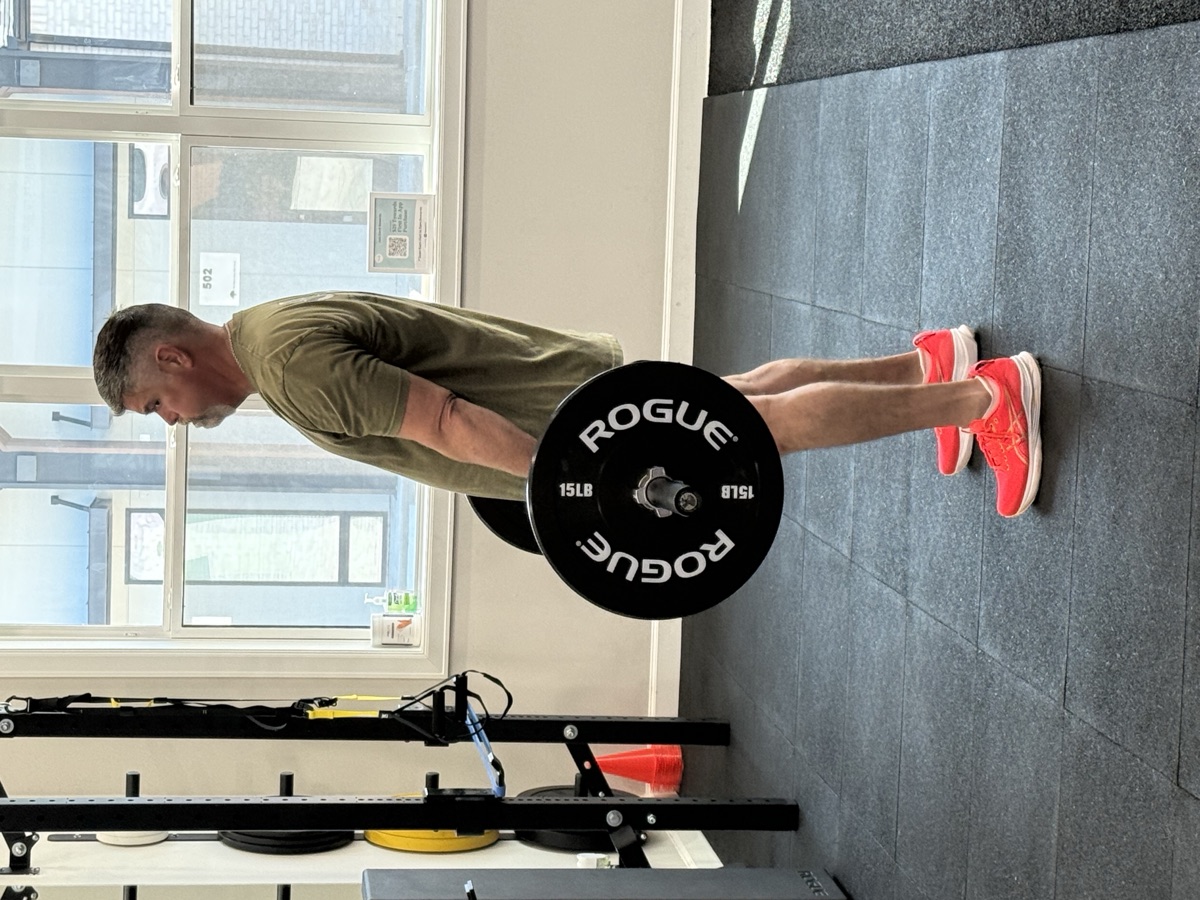
- **Posterior chain loading** — deadlifts, Romanian deadlifts, single-leg deadlifts. The hamstring is the ACL's best friend during deceleration.
We test, retest, and document at week 18 and again at week 22. The numbers tell us what's safe.
Phase 3 — Reintroduction (Weeks 22-28) A first jog isn't a mile. It isn't even a quarter-mile. It's a walk-jog-walk interval session — typically 1 minute jog, 4 minutes walk, repeated 5 times. Total jog volume on day 1: 5 minutes. We progress only as symptoms allow.
Symptom rules:
- **Pain ≤ 2/10 during** is acceptable.
- **Soreness that resolves within 24 hours** is normal training response, not damage.
- **Pain that lingers past 48 hours, or swelling that returns**, means we back off and reload capacity for another 1-2 weeks.
Progression: each week we increase total jog time by ~10%. Continuous jogging usually arrives around week 28-32 if everything else cooperates. A return to sport-specific running drills follows by week 36-40 for most athletes.
What we test before clearing for full return Even after running is comfortable, we don't clear athletes for full return-to-sport until they pass:
- **Hop test battery at 95%+ symmetry** (single, triple, crossover, 6m timed).
- **Star Excursion Balance Test at 90%+ symmetry.**
- **Y-Balance Test composite within 90% bilateral.**
- **Quadriceps strength at 95%+ symmetry on an isokinetic dynamometer.**
- **Psychological readiness scale (ACL-RSI)** scoring above 60. Mental readiness predicts re-tear independently of physical metrics.
Skipping the psychological piece is a mistake we used to make and don't anymore. Patients who don't trust their knee compensate in ways their own brain can't see, and those compensations re-tear knees.
The hardest part isn't the surgery The hardest part of ACL rehab is the patience to clear each checkpoint instead of skipping ahead. Most re-tears we see happen in patients who returned to sport before passing the full test battery, usually because their season started or their team needed them.
If you're 4-12 months post-ACL and weighing your next move, the conversation we want to have isn't "when can I run." It's "what does my knee need to demonstrate before running is a good idea, and how do we get there fast and safely." Cleared on capacity beats cleared on calendar every time.
Ready to talk through your situation?
Dr. Ken sees patients one-on-one in Katy, TX — plus virtual and select in-home visits. Cash-pay, no referral required.