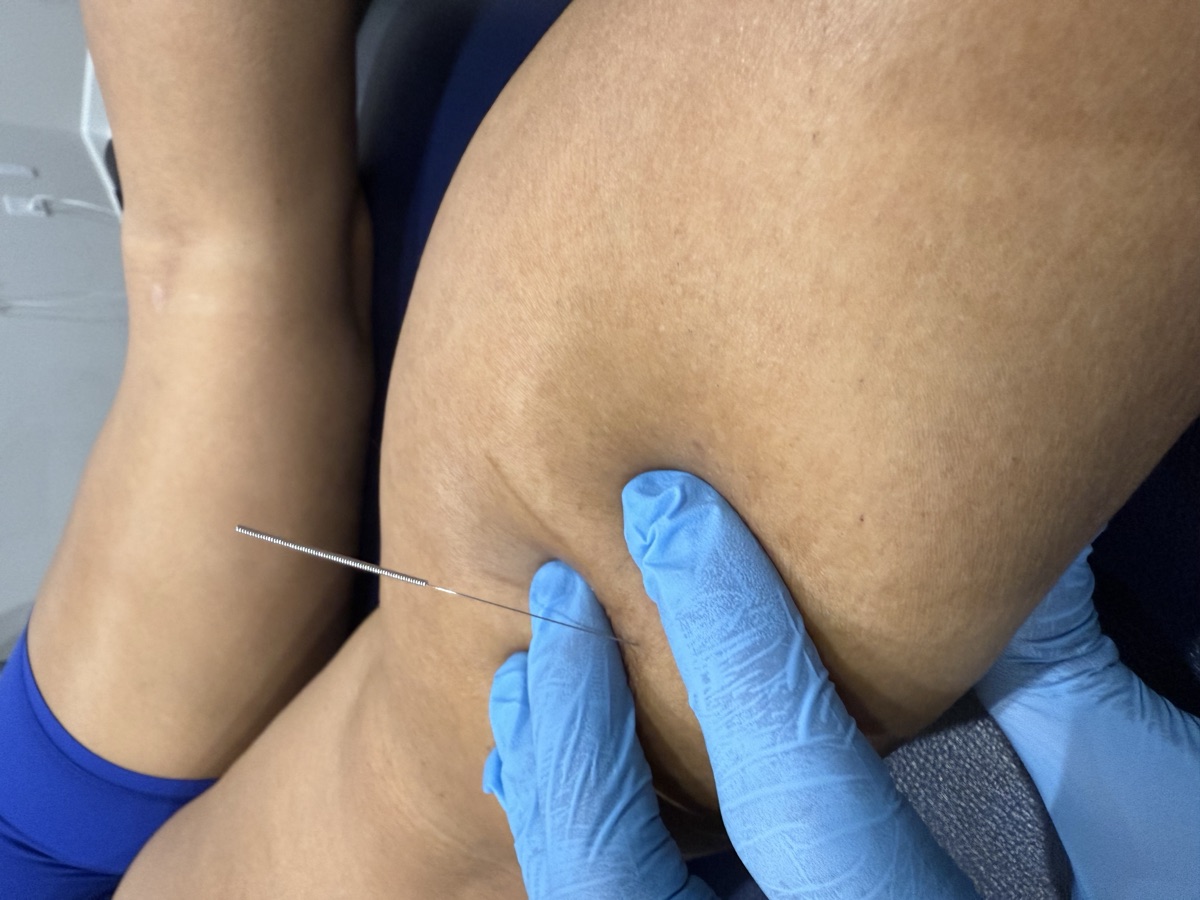
If you have tight, stubborn muscle pain that hasn't budged with stretching, massage, or rest alone, dry needling may be the piece missing from your recovery plan. At Elev8 Physical Therapy & Performance in Katy, TX, Dr. Kenneth Nwosu, PT, DPT, C-PS — certified in dry needling — uses this technique as one targeted tool inside a comprehensive, doctor-led treatment plan.
Here's what you need to know before your first session.
What Dry Needling Actually Does
Dry needling uses a thin, sterile filiform needle to penetrate the skin and target a myofascial trigger point — an irritable, contracted knot within a muscle. When the needle contacts the trigger point, it provokes a brief local twitch response: an involuntary micro-contraction that releases the muscle, reduces the electrical activity holding it in spasm, and restores normal circulation to tissue that's been starved of blood flow.
The result is reduced pain, improved range of motion, and a muscle that can finally respond properly to strengthening and mobility work. That last part is key: dry needling clears the blockage so the rest of your physical therapy can actually take hold.
It is not acupuncture. Both use similar needles, but dry needling is grounded in musculoskeletal anatomy and neuroscience — not meridian theory. Dr. Ken applies it as a targeted clinical tool, not as a standalone treatment.
Conditions Treated at Elev8
Dr. Ken reaches for dry needling when the evidence and the clinical picture support it. Common presentations include:
- Chronic low back and neck pain — especially cases where muscle guarding and trigger points have persisted beyond the initial injury phase
- Shoulder pain — rotator cuff injuries, frozen shoulder, shoulder impingement with secondary muscle tightness
- Tennis elbow and golfer's elbow — lateral and medial epicondylalgia that hasn't responded to load management alone
- Hip and IT band pain — including piriformis syndrome and TFL tension contributing to lateral knee pain
- Plantar fasciitis and Achilles tendinopathy — alongside shockwave therapy when appropriate
- Post-surgical muscle inhibition — when the nervous system is still "guarding" muscle after a procedure, preventing normal activation
- Sports injuries — hamstring strains, quad tightness, calf knots, and other sports-related trigger-point patterns in athletes returning to training
- Headaches stemming from cervical and upper trapezius trigger points
If your pain is primarily structural — a disc herniation, ligament tear, or bony impingement — dry needling alone won't fix the underlying problem. Dr. Ken's evaluation determines whether it's appropriate and what role it plays in the full plan.
What Your First Session at Elev8 Looks Like
Dry needling at Elev8 is always preceded by an evaluation. Dr. Ken identifies the root cause of your pain first — not just where it hurts, but why — before placing a single needle.
Initial evaluation (first visit): Dr. Ken takes a full history, performs a movement assessment, identifies active and latent trigger points through palpation, and explains what he found and why dry needling is or isn't appropriate for your presentation. You leave with a clear plan, not just a single treatment.
The needling itself: Needles are placed into identified trigger points, held briefly, and removed. You may feel a dull ache, a local pressure, or a brief twitch response — all normal. Sessions typically last 10–20 minutes for the dry needling component, integrated into a full hour-long treatment that may also include manual therapy, exercise, or cupping depending on your plan.
After the session: Mild soreness — similar to a hard workout — can persist for 12–24 hours. Most patients notice measurable improvement within 24–48 hours. Dr. Ken will give you specific aftercare instructions (hydration, gentle movement, what to avoid) before you leave.
How It Fits Your Full Treatment Plan
This is the point most clinics miss. Dry needling is a preparation tool, not a destination. Releasing a trigger point creates a window — a brief period where the muscle is more receptive to strengthening, stretching, and neuromuscular re-education. At Elev8, Dr. Ken builds that window into your plan deliberately. You don't just get needled and sent home; you follow up with targeted exercises that reinforce the tissue change and prevent the trigger point from reactivating.
That sequence — release, activate, load — is what produces lasting results instead of temporary relief.
What to Bring to Your First Session
- Comfortable clothing that allows access to the area being treated (shorts for leg/hip work, a tank or loose tee for upper body)
- A list of current medications (some blood thinners require modified technique)
- Any imaging reports (MRI, X-ray) relevant to your condition
- Questions — Dr. Ken spends the full session with you, and there's time to ask them
No Referral. No Insurance Hassle. Just One-on-One Care.
Elev8 is a cash-pay, direct-access practice. You don't need a referral or prior authorization to start. Cash, credit, FSA, and HSA are all accepted. Dr. Ken sees you one-on-one for the full session — no tech handoff, no rotations, no five-minute check-ins.
If you're in Katy and dealing with pain that hasn't responded to the standard approach, dry needling integrated into a real physical therapy plan is worth exploring. Call us at (346) 617-2449 or use the booking link below to schedule your initial evaluation.