You took two weeks off. Then four. You iced it, stretched it, wore a brace, and tried every variation of rest that felt reasonable. The pain dropped — maybe to a two out of ten — but it never went to zero. You went back to your activity and within a week or two, it was a five again. This is the pattern we hear constantly at Elev8, and it is not a mystery once you understand what is actually happening in the tissue.
Chronic nagging injuries — the heel that flares every morning, the knee that never quite settles, the shoulder that limits overhead reach — are not failing to heal because you are not resting enough. They are often failing to heal because you are resting. The biology of tendon and fascial repair requires load to progress. Without the right kind of load, these structures get stuck in a degenerative loop that rest alone cannot interrupt.
The difference between acute inflammation and chronic degeneration
This distinction is the most important concept in understanding why nagging injuries behave so differently from fresh ones. Acute inflammation — the swelling, heat, and pain in the first 72 hours after an injury — is the body's correct first response. Blood flow increases, inflammatory cells arrive, damaged tissue is cleared. This is a productive process and it does respond to rest and ice and relative offloading.
Chronic tendinopathy is a completely different condition. Under imaging, the tissue shows disorganized collagen, micro-tears that have laid down scar tissue in a non-functional orientation, reduced vascularity, and changes in the cellular environment — more proteoglycans, more water content, altered ground substance. There is no significant active inflammatory process present. That is why anti-inflammatories — both NSAIDs and cortisone injections — provide only temporary relief for most chronic tendon conditions. They are suppressing inflammation that is no longer the main driver of your pain.
What is driving your pain is a structurally compromised tendon or fascial structure that cannot generate or transmit force properly, combined in many cases with central sensitization — a nervous system that has been receiving pain signals long enough that it has become more sensitive to stimulation, not less.
Why rest makes chronic injuries worse over time
Tendons adapt to the mechanical demands placed on them. This is not a metaphor — it is a physiological reality. Collagen turnover and organization, vascular supply, and cellular signaling in tendon tissue are all regulated by mechanical load. When load drops to zero, the tissue does not repair itself in a strengthened orientation. It continues to degenerate or at best remains in a compromised state.
The specific cellular mechanism involves mechanoreceptors on tenocytes — the primary cells in tendon tissue — that detect strain. When strain is within a productive range, tenocytes produce new collagen and suppress degradative enzymes (matrix metalloproteinases). When strain drops too low for too long, tenocytes reduce their anabolic output, and the balance shifts toward continued degeneration. Rest is an excellent strategy for protecting acutely injured tissue. For a tendon that has been stuck in a failed-healing state for three or more months, rest is not a treatment — it is a delay.
What actually breaks the cycle
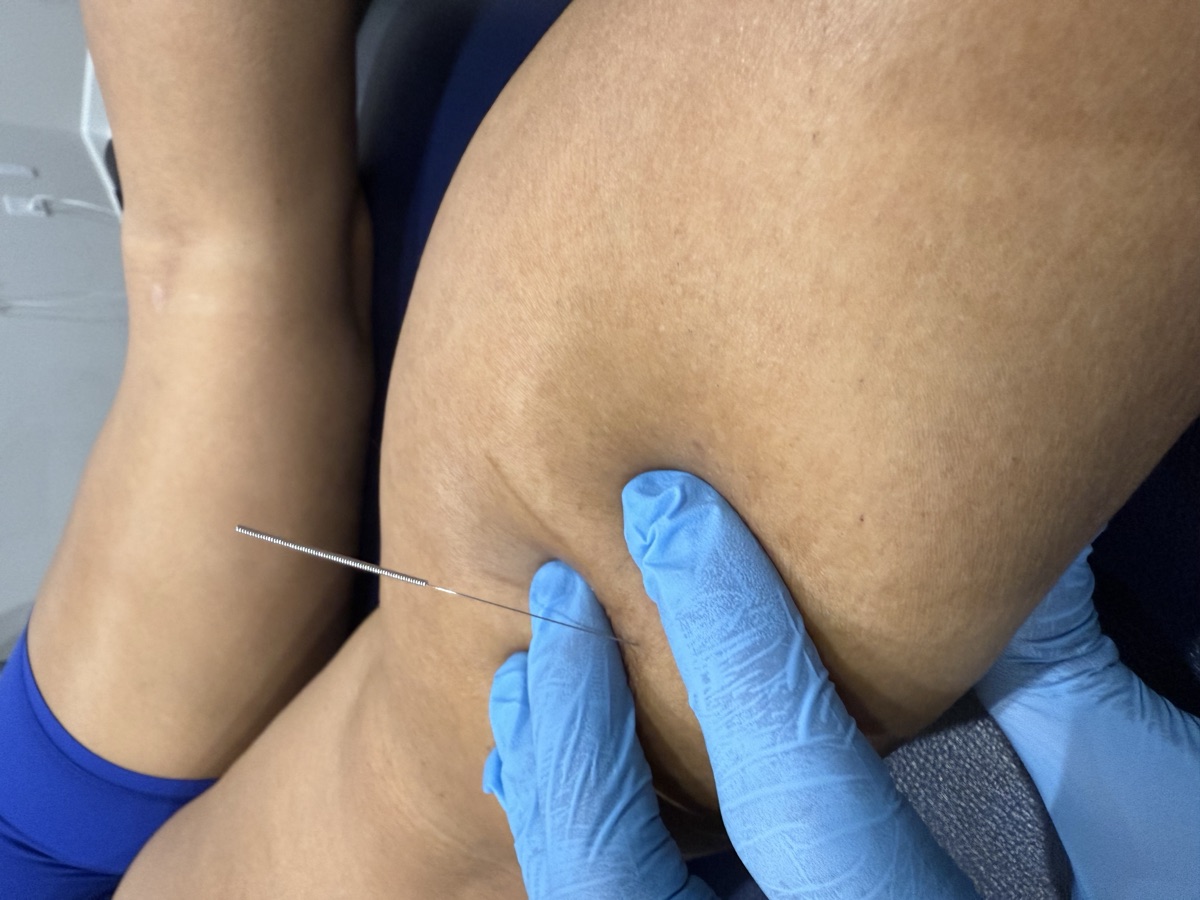
The research on chronic tendinopathy converges on a clear answer: progressive mechanical loading is the primary intervention, often in combination with manual therapy to address associated muscle guarding, trigger points, and movement restrictions.
Isometric loading is typically the starting point. Sustained muscle contractions with no joint movement load the tendon without the stress of dynamic activity. The research on patellar and Achilles tendinopathy shows isometric holds reduce pain acutely and begin to stimulate the biological repair process, making them an effective entry point when pain is high and dynamic loading is not yet tolerable.
Eccentric loading — lengthening the muscle under load — has the strongest long-term evidence for many tendinopathies. Eccentric heel drops for Achilles, eccentric step-downs for patellar tendon, and eccentric wrist extensions for tennis elbow are among the most well-supported interventions in sports medicine. They are also frequently done wrong — too aggressively, without enough volume, or without the appropriate progressions — which is why so many patients try them and report only partial success.
Heavy slow resistance training has been shown in several trials to produce equivalent or superior outcomes to eccentric-only protocols, with better patient compliance. The key is heavy and slow — loads that require the tendon to generate significant tension, performed at a cadence that maximizes time under tension.
For cases where loading programs have stalled — where the tendon has been symptomatic for more than six to nine months and loading progressions have plateaued — we add StemWave shockwave therapy to the plan. The acoustic wave disrupts the degenerative loop at the tissue level, stimulating new collagen production and angiogenesis. It works best as a catalyst for a loading program, not as a standalone treatment.
The movement patterns keeping you stuck
One reason nagging injuries persist is that the body is very good at working around them. A painful Achilles leads to reduced ankle dorsiflexion, which shifts load to the knee and hip. A painful rotator cuff leads to altered scapular mechanics, which increases impingement forces. These compensations are intelligent short-term solutions that become long-term problems — they unload the injured tissue just enough that it never gets the stimulus it needs to remodel, while overloading adjacent structures that develop their own problems.
Any treatment plan that does not address the underlying movement drivers is treating a symptom, not a cause. This is why Dr. Ken structures every chronic pain case around a movement screen first — the loading program gets designed around correcting the mechanics that caused the problem, not just loading the tissue that is painful.
When to stop waiting and make a decision
If you have had the same nagging pain for more than eight to twelve weeks and it is limiting your activity — whether that is running, lifting, playing with your kids, or getting through a workday without discomfort — that injury is not going to resolve with more rest. The window for spontaneous resolution has passed. What it needs is a graded loading program, potentially some manual work to restore mobility and reduce guarding, and in some cases an advanced modality to restart the biological repair process.
We see this pattern weekly at Elev8: patients who waited six months, twelve months, two years — genuinely believing the injury would eventually settle — who needed eight to twelve weeks of targeted work to get to the outcome rest never delivered. The earlier you address a chronic tendinopathy with the right interventions, the faster the resolution. Every additional month of maladaptive tissue change makes the path back longer.
If you have a nagging injury that is not resolving in Katy, TX or the greater Houston area, bring it in. We will tell you exactly what is happening and what it will take to fix it.